





Enterprise AI Governance: A Practical Framework for Securing AI Applications, Agents and Data
Artificial intelligence is becoming an integral part of enterprise operations. Employees use public GenAI applications for everyday tasks, developers integrate language models with internal systems, and organisations are increasingly deploying autonomous agents to automate business processes.
These applications interact with enterprise data in different ways. Some process information supplied by employees, while others retrieve data from internal repositories, invoke APIs or execute actions across connected applications.
Enterprise AI Governance provides the policies, processes and controls needed to manage these interactions responsibly. Most organisations begin with acceptable-use policies, approved-tool lists, risk assessments and periodic reviews. These measures establish important governance foundations.
As AI adoption expands across applications, models and autonomous agents, organisations also need mechanisms to apply these policies consistently during actual AI usage.
Enterprise AI Governance must evolve from documenting acceptable behaviour to enforcing it across every AI interaction.
What Is Enterprise AI Governance?
Enterprise AI Governance is the framework of policies, accountability, technical controls and oversight mechanisms used to manage AI systems throughout their lifecycle.
- Security: Protecting applications, models, identities and enterprise data.
- Privacy: Controlling how personal and confidential information is processed.
- Accountability: Establishing ownership of AI systems and their decisions.
- Compliance: Demonstrating adherence to applicable regulations and organisational requirements.
- Operational control: Monitoring AI behaviour and enforcing restrictions during execution.
Frameworks such as the NIST AI Risk Management Framework and ISO/IEC 42001 provide useful foundations for establishing governance responsibilities, assessing risks and implementing management processes. However, these frameworks do not automatically translate policies into technical enforcement.
An organisation may have an approved AI policy, a documented risk assessment and an inventory of sanctioned tools while still allowing sensitive data to reach an unauthorized AI service. This is the distinction between having an AI Governance framework and operating an effective AI Governance architecture.
Why Traditional AI Governance Is No Longer Sufficient
Early enterprise AI initiatives primarily focused on employee use of public GenAI applications. Security teams introduced acceptable-use policies, approved-tool lists, employee training and restrictions on sharing confidential information. These measures addressed an important problem: Shadow AI.
However, the enterprise AI environment has expanded considerably.
Public GenAI applications: Employees access ChatGPT, Claude, Gemini and other AI services through browsers and desktop applications.
Self-hosted models: Engineering teams deploy language models connected to internal databases, document repositories and Retrieval-Augmented Generation (RAG) systems.
Autonomous agents: AI agents invoke tools, execute code, call APIs and delegate tasks through mechanisms such as MCP and agent-to-agent communication.
Embedded SaaS AI: Enterprise applications introduce copilots and agents that operate through existing permissions, OAuth grants and SaaS APIs.
Each environment introduces different access paths and security boundaries. A network gateway may observe browser traffic but not an internal agent invoking a database API. An Identity Provider may authenticate a user without determining whether an AI agent should execute a particular operation. Consequently, governance cannot depend on a single control point or periodic compliance assessment.
From an AI Governance Checklist to an Enforcement Layer
Most enterprises begin AI Governance with a checklist:
- Identify approved AI applications.
- Define acceptable-use policies.
- Assess privacy and security risks.
- Establish access guidelines.
- Conduct periodic compliance reviews.
- Train employees on responsible AI usage.
These activities establish organisational expectations, but they do not necessarily prevent violations. An operational AI Governance layer converts those expectations into enforceable security decisions.
For example, a policy stating that employees must not upload customer information to public AI services should translate into controls that identify the user, inspect the content, determine the destination and prevent unauthorized disclosure.
Similarly, a policy requiring least-privilege access for autonomous agents must govern the permissions used when an agent invokes tools or delegates tasks. This requires integrating identity, authorization, data protection and runtime monitoring into the AI execution environment.
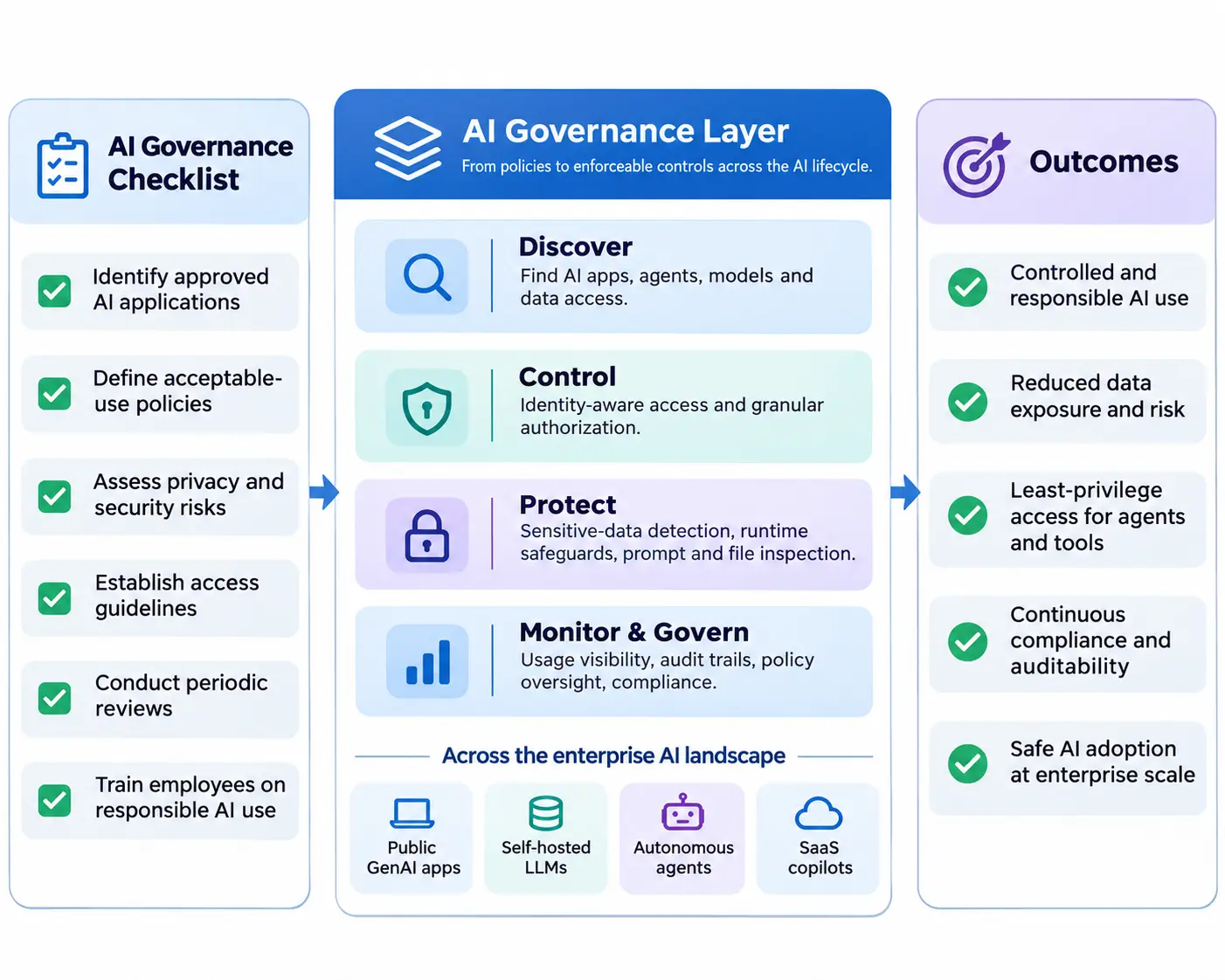
Five Essential Components of an Enterprise AI Governance Architecture
1. Continuous AI Discovery and Visibility
Governance begins with understanding where AI operates. Security teams need visibility into sanctioned and unsanctioned AI applications, embedded SaaS capabilities, internal models, autonomous agents and MCP servers. Discovery should extend beyond application names to identify users, connected datasets, API integrations, permissions and data flows. This provides the foundation for risk classification and policy enforcement.
2. Identity-Aware Access Control
AI access decisions should consider the identity of the user, application, device and agent initiating an interaction. Policies should evaluate contextual attributes such as user role, device posture, location, application trust and business requirements. For autonomous systems, every agent should have a verifiable identity and appropriately scoped credentials. An agent acting on behalf of a user should not automatically inherit unrestricted access to every resource available to that user.
3. Granular Authorization and Delegation
Authentication establishes identity. Authorization determines permitted actions. In agentic workflows, authorization should evaluate User × Agent × Model × Tool × Dataset. Consider an AI assistant authorized to retrieve a customer record. That permission should not implicitly authorize bulk database exports or destructive operations. Delegated permissions should narrow as tasks move between agents, following least-privilege principles. This reduces the potential impact of compromised credentials, excessive privileges and unintended agent behaviour.
4. Runtime Data Protection and Security Controls
AI systems process information through prompts, file uploads, retrieved context, API calls and generated responses. Controls must therefore operate at the point of interaction. These include sensitive-data classification, PII and PCI detection, source-code protection, prompt-injection mitigation, tool-argument validation and restrictions on unauthorized data transfers. High-risk actions may require explicit human approval before execution. Runtime controls are particularly important because a previously authorized AI system can still perform an unsafe action.
5. Continuous Monitoring, Audit and Accountability
Governance requires evidence that policies are operating as intended. Security teams should capture relevant AI usage, access decisions, policy violations, agent activities and approval events. Integration with SIEM and security operations workflows enables investigation, incident response and compliance reporting. Audit records should connect actions to the responsible human or machine identity while respecting privacy and data-retention requirements.
Aligning AI Governance with NIST AI RMF, GLBA and ISO 42001
Technical enforcement should complement established governance frameworks and regulatory requirements rather than replace them.
The NIST AI Risk Management Framework (AI RMF) structures AI risk management around four functions: Govern, Map, Measure and Manage.
ISO/IEC 42001 establishes requirements for an AI management system, including organisational responsibilities, risk management and continual improvement.
For US financial institutions, specifically, the Gramm-Leach-Bliley Act (GLBA) requires safeguards to protect customers' nonpublic personal information. Applicable implementing requirements establish expectations for risk assessments, access controls, data protection and ongoing security oversight. As banks, credit unions and other financial institutions adopt AI applications and autonomous agents, these safeguards become relevant to how customer financial information is accessed, processed and shared through AI systems.
An operational AI Governance architecture supports these requirements through identity-aware access controls, sensitive-data protection, least-privilege authorization, continuous monitoring and auditable security decisions.
For example, an organisation can demonstrate not only that it prohibits unauthorized sharing of customer information with AI services, but also how those restrictions are enforced and monitored. This moves compliance from policy declarations toward verifiable operational controls.
Implementing AI Governance Without Disrupting Adoption
Enterprises should introduce controls progressively.
First 30 days: Discover AI usage, classify applications and data exposure, establish ownership and identify high-risk interactions.
Days 31–60: Implement identity-aware access policies, sensitive-data inspection, sanctioned-tool controls and audit logging.
Days 61–90: Extend enforcement to internal models, agents and tool integrations. Introduce delegated authorization, approval workflows and continuous control validation.
The objective should be proportionate enforcement: permitting legitimate AI usage while restricting actions that introduce unacceptable risk.
Zaperon's Approach to Identity-Centric AI Governance
At Zaperon, our approach is to extend identity-centric security across enterprise AI applications, models, agents and data interactions.
By combining AI discovery, identity-aware access controls, data protection and runtime policy enforcement within an integrated security architecture, Zaperon helps organisations apply consistent security decisions across supported AI channels.
This extends established Zero Trust principles beyond conventional application access into AI-driven workflows. Our Agentic AI Gateway architecture builds on this approach by extending identity, authorization and runtime controls across interactions involving AI agents, models, tools and enterprise data.
The objective is not to replace organisational governance processes, but to provide technical controls that help enforce their requirements.
Conclusion
Enterprise AI Governance is moving beyond inventories, policies and periodic risk assessments. As AI systems gain access to enterprise information and increasingly execute actions autonomously, governance must operate where those interactions occur.
An effective architecture connects discovery, identity, authorization, data protection and continuous monitoring.
For CISOs and CIOs, the important question is no longer whether an AI Governance policy exists. It is whether the organisation can consistently enforce that policy across the AI systems accessing its applications and data.


