





Why is Continuous Device Trust Important?
As the workforce becomes increasingly distributed and the number of connected devices grows, managing digital access to corporate resources has become a formidable task for information security teams. These devices, ranging from PCs, smartphones, wearables to medical devices and IoT-enabled gadgets, each possess a unique digital device identity. Ensuring the security of these identities is crucial, considering the expanding scope of technology and the rising prominence of cloud-based operations.
To effectively address the complexities of managing access to machine identities, robust cybersecurity measures must be in place. It is imperative for mature cybersecurity programs to evaluate the integrity and trustworthiness of each identity before granting access to corporate resources. This blog delves into the significance of establishing trust in device identities.
What is Continuous Device Trust?
Continuous device trust is an advanced security approach that ensures ongoing validation of a device's security posture before granting it access to organizational resources. Unlike traditional methods that perform a one-time verification, continuous device trust involves continuous monitoring and assessment of various parameters to maintain an optimal security state.
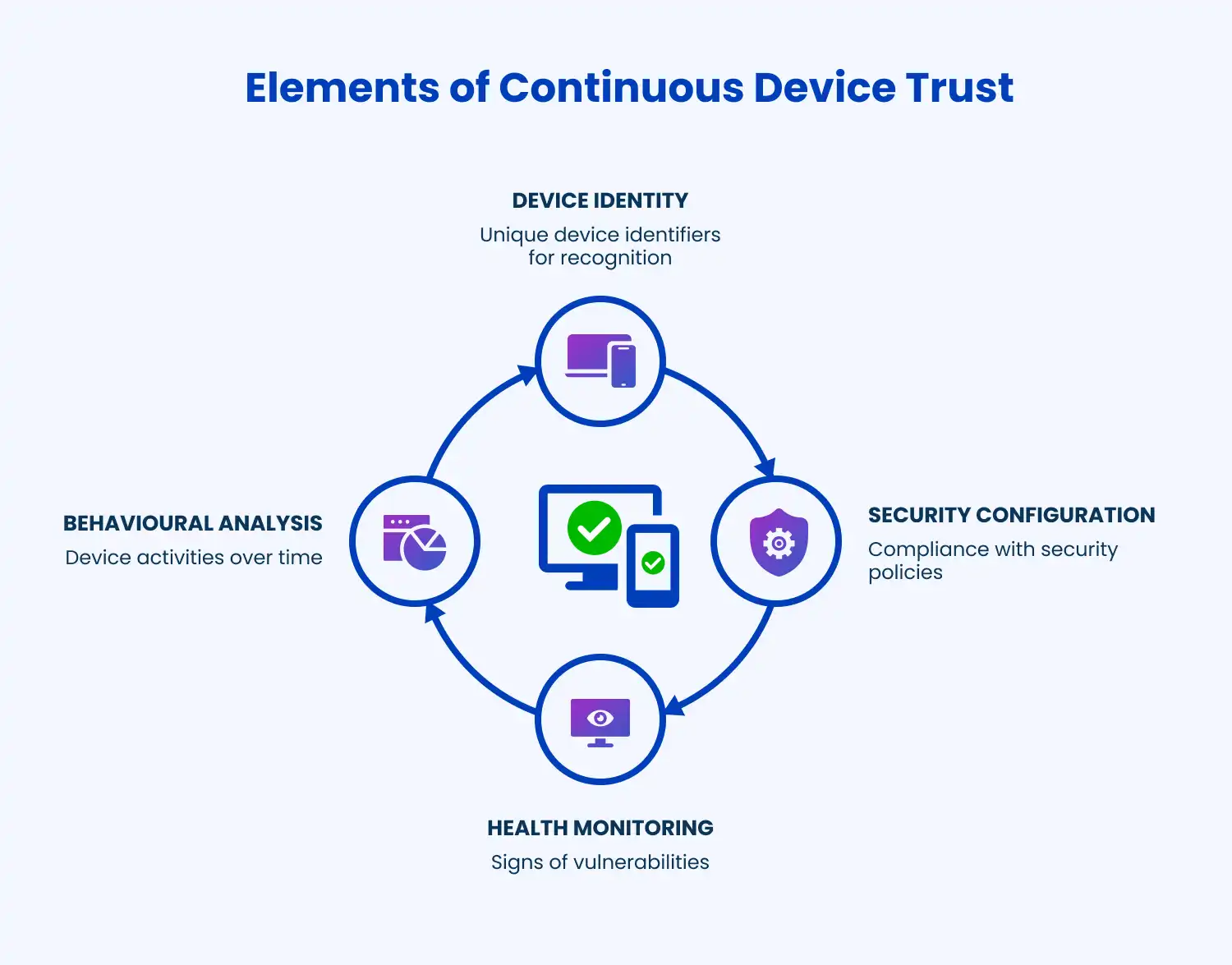
In continuous device trust, multiple factors are considered to evaluate a device's trustworthiness, including:
- Device Identity: Verifying unique identifiers such as MAC address, disk storage, screen size, RAM, operating system, Security Status, GPS coordinates, etc., to ensure it is a recognized and authorized device within the network.
- Security Configuration: Assessing device security settings to comply with organizational policies, including security software, up-to-date patches, and proper encryption.
- Behavioral Analysis: Monitoring activities and behavior patterns over time; deviations may indicate potential threats, triggering further investigation or access restrictions.
- Health Monitoring: Continuous checks for signs of compromise, such as malware infections or unauthorized access, including scanning for vulnerabilities and system integrity verification.
Why is Continuous Device Trust Important?
The benefits of continuous device trust are multifaceted:
- Enhanced Security: Constant verification reduces unauthorized access and data breaches.
- Zero Trust Implementation: Forms a critical building block for zero trust models—every device undergoes verification regardless of origin.
- Improved Compliance: Supports adherence to HIPAA, PCI DSS, GDPR, RBI, SEBI, IRDAI, and other regulations.
- Reduced Risk in BYOD Environments: Securely integrates personal devices while ensuring they meet security baselines.
- Enhanced Remote Workforce Security: Ensures only secure devices access critical resources, regardless of location.
Device Verification Procedure
To ensure device integrity, companies authenticate them from initial connection to trust establishment as follows:
- Initial Device Connections: Devices connect to the network, initiating verification. Access management engines scan for anomalies; BYOD devices follow stricter rules.
- Device Identification: Assign unique device identity using attributes such as:
- MAC Address: Ensures precise identification.
- Digital Certificate: Company-issued for future verification.
- Disk Storage Capacity: Confirms compliance with data/security requirements.
- Screen Size & Resolution: Verifies suitability for secure viewing.
- RAM: Ensures performance compliance.
- OS Version: Confirms updates and policy adherence.
- Security Status: Checks antivirus, encryption, firewalls.
- GPS Coordinates: Ensures operation within approved regions.
- User Verification: Identity authentication using certificates, passwords, MFA, biometrics, or tokens.
- Device Profiling: Device OS, hardware specs, and software versions gathered.
- Compliance Verification: Devices checked against internal policies.
- Trust Establishment: Devices meeting all criteria are trusted.
- Access Control: Trusted devices gain access to authorized resources.
- Continuous Monitoring: Ongoing checks ensure trust is maintained and threats are detected in real-time.
In conclusion, continuous device trust is essential for modern cybersecurity strategies, enabling real-time threat detection, granular access control, and regulatory compliance.
Zaperon: The Ultimate Shield for Your Digital Assets
Zaperon is an Identity-centric Security Service Edge (SSE) platform protecting organizations from credential attacks across users, devices, applications, and cloud infrastructure. Unlike traditional IAM and ZTNA solutions, Zaperon uses PKI-based authentication, phishing-resistant MFA validating 15+ factors, continuous zero trust enforcement, and proactive identity threat detection. It ensures comprehensive security at all enterprise levels with seamless access and advanced monitoring.


