

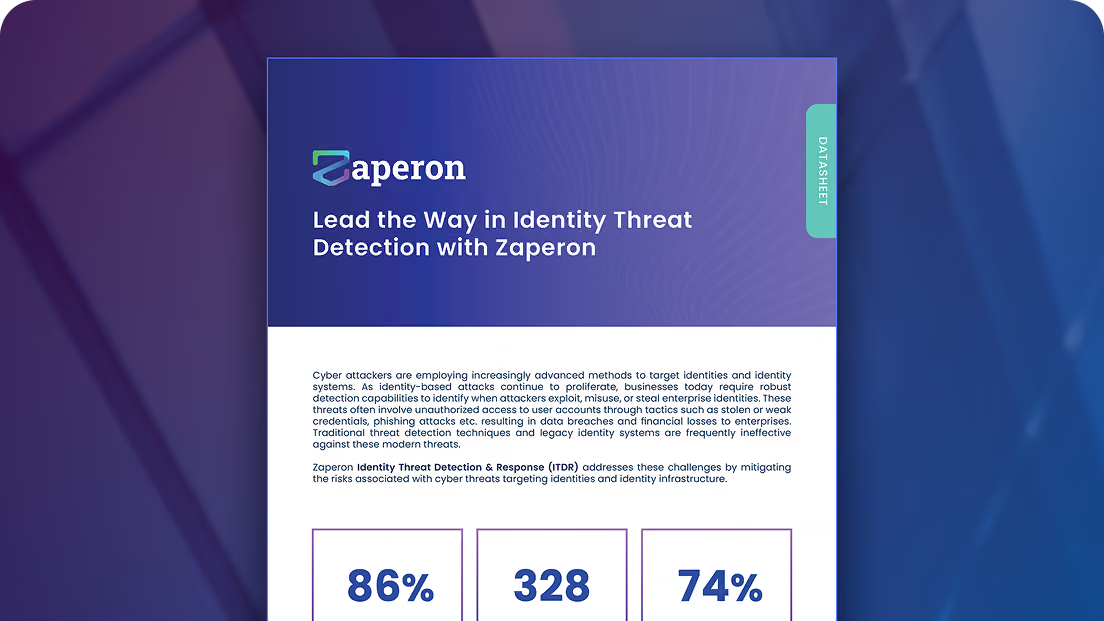
Lead the Way in Identity Threat Detection with Zaperon
Cyber attackers are increasingly targeting user identities and identity management systems to gain unauthorized access to enterprise resources. Through stolen credentials, weak passwords, phishing attacks, and compromised devices, attackers can exploit legitimate user accounts to access sensitive information and cause significant business damage.
Traditional threat detection methods and legacy identity systems often struggle to identify these sophisticated attacks, leaving organizations exposed to data breaches and financial losses.
According to the Verizon Data Breach Investigation Report 2023, 86% of data breaches involve compromised credentials, while 74% involve the human element. The IBM Cost of a Data Breach Report 2023 also highlights that identifying and containing breaches resulting from stolen credentials takes an average of 328 days.
Zaperon Identity Threat Detection and Response (ITDR) helps organizations address these challenges by continuously monitoring identities, user behavior, and device security to identify and respond to identity-based threats.
Understanding Identity Threat Detection and Response (ITDR)
Identity Threat Detection and Response (ITDR) focuses on identifying, investigating, and responding to cyber threats targeting user identities and identity infrastructure.
In modern hybrid work environments, organizations need more than traditional authentication and access controls. They must continuously monitor how users access applications, whether their devices remain secure, and whether their activities match established security policies.
Zaperon ITDR establishes a baseline of normal user behavior, device posture, and Zero Trust access policies. It continuously monitors deviations from this baseline to identify suspicious activities and potential identity compromises.
How Zaperon ITDR Works
Zaperon ITDR follows a continuous security process that combines baseline creation, policy enforcement, monitoring, anomaly detection, and reporting.
1. Baseline Creation
Zaperon creates a baseline of normal user behavior, device posture, and Zero Trust access policies through its cloud controller. This baseline helps identify deviations that may indicate potential security threats.
2. Desired User Behavior
Define expected user access based on organizational roles and responsibilities. Administrators can configure application permissions, authorized devices, geolocation restrictions, access timings, and MFA requirements.
Access policies can also restrict data transfers through USB, Bluetooth, and AirDrop, as well as access to files stored in cloud applications such as Google Drive, OneDrive, and SharePoint.
3. Desired Device Posture
Establish security requirements that devices must meet before accessing enterprise resources.
These include:
- Operating System Version: Define the required operating system versions across Windows, macOS, and Linux devices.
- Antivirus and Anti-Malware Protection: Ensure devices have active and updated security protection.
- Patch Level: Require operating systems to have the latest security patches and updates.
- IP Address: Define permitted and restricted IP address ranges through whitelisting and blacklisting.
4. Policy Enforcement
Zaperon enforces configured security policies through an endpoint agent on user devices, ensuring that access requirements are continuously maintained.
5. Continuous Monitoring
The platform continuously assesses user behavior and device posture against established baselines. Any policy violation or anomaly can trigger access restrictions and alerts for IT administrators.
6. Logging and Reporting
Capture changes in user behavior, device posture, and application access through detailed system logs. Administrator activities are also recorded to track privileged actions and potential privilege escalation.
Visual dashboards provide security teams with real-time visibility into user access, device compliance, and ongoing activities.
Real-Time Identity Anomaly Detection
Zaperon ITDR proactively identifies identity-based threats by monitoring suspicious activities across users, applications, devices, and locations.
Its anomaly detection capabilities include:
1. Unauthorized Access Prevention
Immediately block users attempting to access applications they are not authorized to use or accessing enterprise resources through unassigned devices. This enforces least-privilege access and helps prevent lateral movement.
2. Device Security Monitoring
Monitor changes in device security configurations, including antivirus deactivation, outdated firmware, and network changes. Access from insecure devices can be blocked to prevent potential security compromises.
3. Location Anomaly Detection
Use historical geolocation data to identify unusual user access locations. Security teams receive alerts when suspicious location changes are detected, while users restricted by geolocation policies are denied access from unauthorized locations.
4. Locked and Inactive User Identification
Monitor user activity status and identify locked accounts or users showing minimal activity, such as accounts with no recent application access. Security teams can investigate these accounts to identify potential risks.
5. Failed Authentication Detection
Continuously monitor unsuccessful login attempts across the Zaperon portal and enterprise resources. Suspicious authentication patterns are flagged to help identify potentially compromised user accounts.
Key Use Cases of Zaperon ITDR
Zaperon ITDR helps modern enterprises strengthen identity security through proactive threat detection, automated response, and continuous monitoring.
- Advanced Threat Detection: Identify sophisticated identity-based threats through real-time anomaly detection and monitoring of potential security breaches.
- Automated Incident Response: Block unauthorized access to enterprise resources and flag suspicious accounts, reducing the time between threat detection and remediation.
- User Behavior Analytics: Monitor and analyze user behavior patterns to identify deviations that may indicate insider threats or compromised accounts.
- Endpoint Protection: Continuously assess device security posture to identify vulnerabilities, malware risks, and non-compliant devices.
- SIEM Integration: Integrate with Security Information and Event Management (SIEM) systems to improve security event correlation, analysis, and overall visibility.
Strengthen Identity Security with Zaperon ITDR
Identity-based attacks can remain undetected when organizations rely solely on traditional authentication and security monitoring methods. Protecting enterprise identities requires continuous visibility into user behavior, device health, access patterns, and suspicious authentication activities.
Zaperon Identity Threat Detection and Response combines baseline monitoring, Zero Trust policy enforcement, proactive anomaly detection, and automated access restrictions to help organizations identify and respond to identity threats.
By protecting users, devices, applications, and cloud infrastructure, Zaperon helps enterprises reduce identity-based risks and strengthen their overall cybersecurity posture.