





What is Zero Trust Security?
As Zero Trust Security continues its trail of gaining popularity, it is also brewing backlash among professionals who believe the term has been diluted beyond all usefulness.
At global conferences, you may find businesses vending solutions with the questionable moniker "ZTA". They even brag about their Zero Trust programs while offering as many exceptions as regulations.
And that mixed reaction stirs up the controversy of whether Zero Trust Security is our best hope in the turbulent security ecosystem, or is it just another tech buzzword?
The answer lies in the 2-decade long history of Zero Trust and how it has evolved over time to create a fool-proof security landscape for businesses.
What led to the rise of the Zero Trust Model?
It was not until the year 2009 that the name "Zero Trust Model" was coined by Forrester’s John Kindervag. However, its origins began even before it got its now-famous name. While the Zero Trust model in its early days was not more than a notion constructed in a non-linear fashion, the concept was born out of similar pain points faced by enterprises across the globe. Prior to this, the enterprise security model was built on the traditional approach of assuming that every resource, device, and individual inside an organization must be implicitly trusted. To impede malicious attempts, network access was protected through firewalls and single log-in methods. Often termed "castle and moat security," this, however, only made sense in a physical office setting or on-prem servers.
But, as the internet boom and its easy access flooded global businesses, it also bleaked the physical parameters around work that demanded more scrutiny.
In the digital ecosystem that consistently escalates with new technology, every organization faces unique challenges in terms of security. This is where Zero Trust security enters the premise of digital transformation maturity to offer a more stable security framework. With more reliance on the internet for work, employees, vendors, clients, and partners needed company data access from anywhere, anytime. This paved the way for the security features of the likes of VPN, which wasn't a fool-proof security shield and could still be compromised.
And as a wave of cataclysmic viruses, online theft, and malicious insiders as well as outsiders penetrated even the firewall-protected networks, the “framework of de-perimeterization” was proposed. This model, later known as the "Zero Trust Security Model,” was based on defense in-depth.
What is Zero Trust Security?
Zero Trust Security is an IT security architecture that encompasses robust identity verification for every device and individual who attempts to access and exploit resources over a private network. Zero trust security is built on the principle of “Never Trust, Always Verify” and has the capability of protecting the sophisticated modern enterprise ecosystem. It identifies that once on a network, an insider could turn malicious and exfiltrate sensitive data either voluntarily or involuntarily due to a lack of granular security controls. The Zero Trust security model protects an organization by eliminating implicit trust while constantly validating each stage of digital interaction.
Benefits of Zero Trust Security Model
Zero Trust security stands for continuous vetting of access requests prior to allowing requests. This opens up a myriad of benefits for the organization implementing the model.
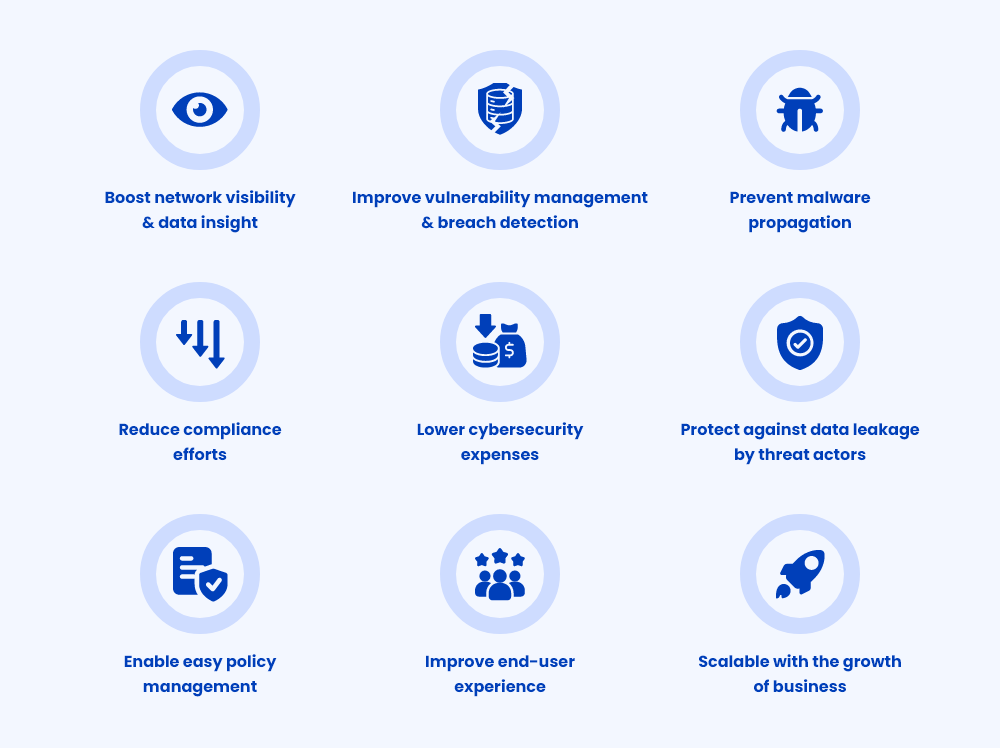
Considering the Zero Trust security model offers segmented access to services and applications, it reduces the potential for an attack to victimize the business. As malicious actors can no longer move laterally within the network, the security model smooths the migration from endpoint detection and response to extended detection and response. According to a 2023 Gartner report, 10% of large-scale organizations will adopt a more measurable and mature Zero Trust security strategy by 2026, up from less than 1% today.
Main principles of a Zero Trust Security Model
Based on the NIST SP 800-207 guidelines, a Zero Trust security model addresses the following key principles:
- Continuous verification: No person or device can be trusted. Every user or device identity must be verified each time access is requested. Periodic re-verification ensures fool-proof security.
- Limit the “blast radius”: Limit users' access only to what they need, reducing the risk of sensitive data exposure.
- Microsegmentation: Break security perimeters into smaller zones. Users with access to one zone cannot access others without authorization.
- Eliminating lateral movement: Prevent attackers from moving across the network after gaining access. Compromised segments can be instantly quarantined.
- Multi-factor authentication: Requires more than just a password to gain access, adding an extra layer of security for users and devices.
How does the Zero Trust Security Framework function?
A Zero Trust security model requires organizations to ensure that their network access to cloud or enterprise assets is properly vetted. This concept relies on real-time visibility with attributes such as:
- User identification and privilege type
- Endpoint identification, hardware type and firmware versions
- Geographical location & access time
- Operating system versions and patch levels
Zero trust network access enables safe remote access to applications and services. This model is based on set access control policies, which prohibit access by default. After authenticating a user through a secure, encrypted tunnel, it establishes access only to authorized apps and services.
Implementing the full Zero Trust model can be overwhelming. This is where Zaperon with its fool-proof security philosophy, eliminates risks. Our framework ensures only genuine users access authorized applications via secure devices.
Additionally, PKI-based passwordless authentication removes credential phishing risks. AI-based continuous risk analysis ensures no phishing, faster remote connectivity, and secure remote access while preventing potential attacks.


