

Shadow AI: How Enterprises Can Discover, Govern and Secure Unmanaged AI Usage
Artificial intelligence is becoming integral to enterprise workflows. Employees use public GenAI applications to analyze information, developers experiment with AI coding assistants, and business teams increasingly rely on AI capabilities embedded within SaaS applications.
However, not all AI adoption happens through approved enterprise systems. Employees may access AI tools through personal accounts, departments may adopt new applications without security reviews, and developers may deploy autonomous agents that interact with enterprise data outside established governance processes.
This growing environment of Shadow AI presents a fundamental challenge for CISOs: how can organizations maintain visibility and control without restricting legitimate AI adoption?
Traditional application inventories, acceptable-use policies and network security controls provide an important foundation. However, they cannot independently determine what sensitive information reaches AI systems or what actions autonomous agents perform.
Managing Shadow AI requires moving beyond application discovery toward identity-aware access control, data protection and continuous monitoring.
What Is Shadow AI?
Shadow AI refers to AI applications, models, agents and integrations used within an organization without appropriate security visibility, authorization or governance. It extends beyond employees accessing ChatGPT through personal subscriptions.
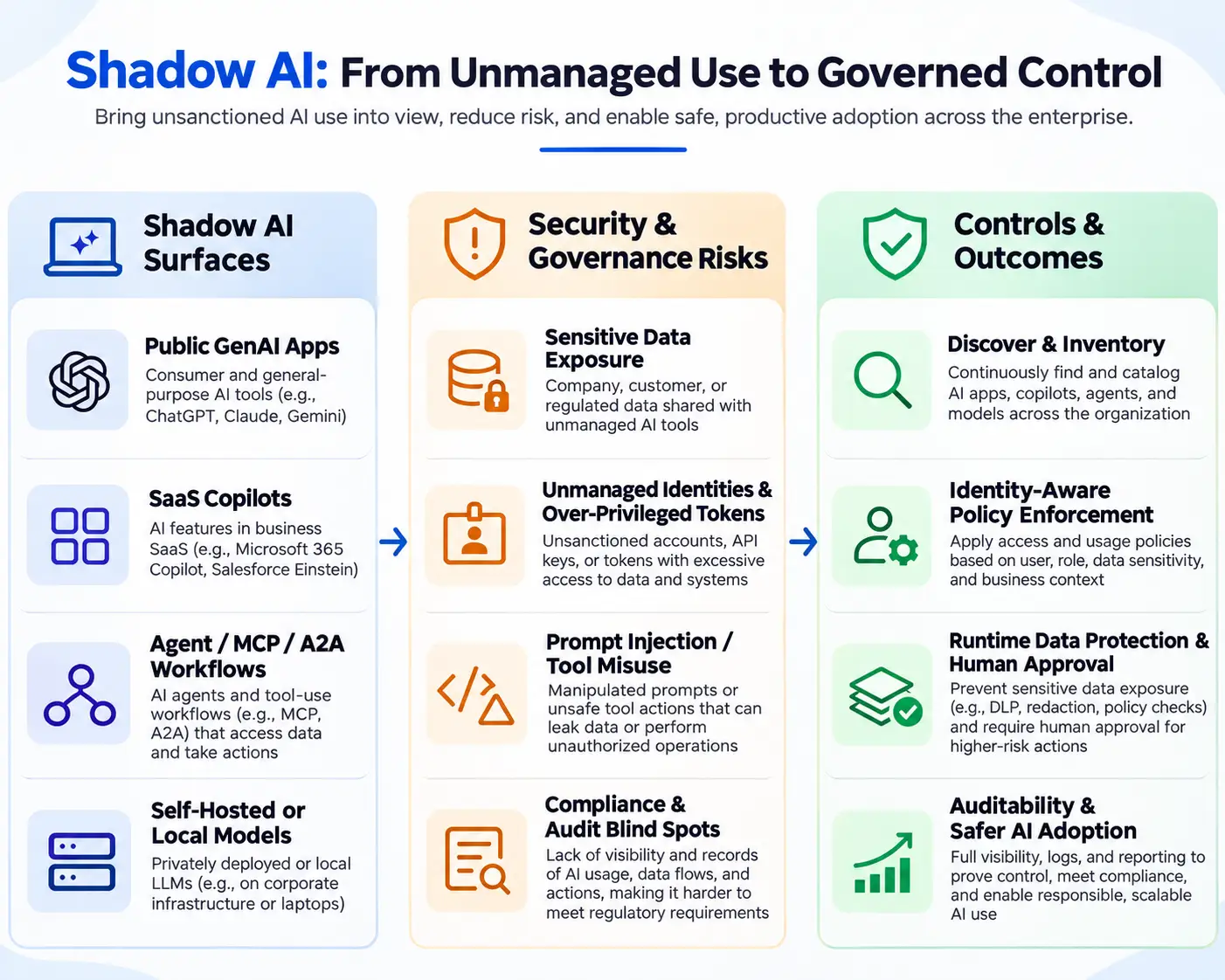
Today, Shadow AI can emerge across four enterprise environments.
1. Public GenAI Applications
Employees access applications such as ChatGPT, Claude and Gemini through browsers, desktop applications or personal accounts. These interactions may involve customer records, financial information, confidential documents or source code.
2. AI Embedded in Enterprise SaaS
Business applications increasingly incorporate copilots and autonomous AI capabilities. Even when the underlying SaaS platform is approved, newly enabled AI features may access organizational information through existing user permissions without a separate security assessment.
3. Autonomous Agents and MCP/A2A Workflows
Developers deploy agents that retrieve information, invoke tools, interact with MCP servers and delegate tasks to other agents. These workflows may operate through API keys, OAuth grants and service identities that security teams have not inventoried.
4. Self-Hosted or Local Language Models
Engineering teams deploy open-source models within corporate infrastructure or on local devices. Although self-hosting provides infrastructure control, it does not automatically establish appropriate authorization, data-access restrictions or monitoring.
Each environment introduces different access paths and security boundaries. Consequently, a single discovery or enforcement mechanism cannot provide comprehensive visibility across every AI interaction.
The Security and Governance Risks of Shadow AI
The primary concern is not simply unauthorized application usage. It is the potential for sensitive information and enterprise permissions to extend beyond established security controls.
Sensitive Data Exposure
Employees may inadvertently submit PII, PCI data, proprietary source code, engineering drawings or confidential business information to unmanaged AI applications. Depending on the service and account configuration, submitted information may be processed or retained outside approved organizational boundaries.
Security teams must understand which information is being shared and whether appropriate safeguards exist.
Unmanaged Identities and Excessive Permissions
AI applications and autonomous agents increasingly access business systems using OAuth permissions, API tokens and service credentials. An unreviewed integration may retain excessive privileges, while agents operating through shared credentials can create accountability gaps.
Compromised or misconfigured identities may expose information beyond the intended business task.
Prompt Injection and Unsafe Tool Execution
Autonomous AI systems introduce risks beyond conventional data disclosure. Malicious instructions embedded in retrieved documents, tool responses or external content may influence agent behavior.
Where an agent has excessive permissions, manipulated instructions can potentially trigger unauthorized data access, API calls or other unsafe operations.
Compliance and Audit Blind Spots
Organizations subject to privacy and security requirements need appropriate oversight of sensitive-data processing. Without visibility into AI interactions, access decisions and data transfers, demonstrating compliance becomes difficult.
Frameworks such as the NIST AI Risk Management Framework and ISO/IEC 42001 provide governance foundations, but technical controls are needed to operationalize relevant requirements.
From Shadow AI Discovery to Continuous Security Enforcement
Effective Shadow AI governance requires a connected approach to discovery, identity, data protection and monitoring.
1. Discover and Inventory AI Usage
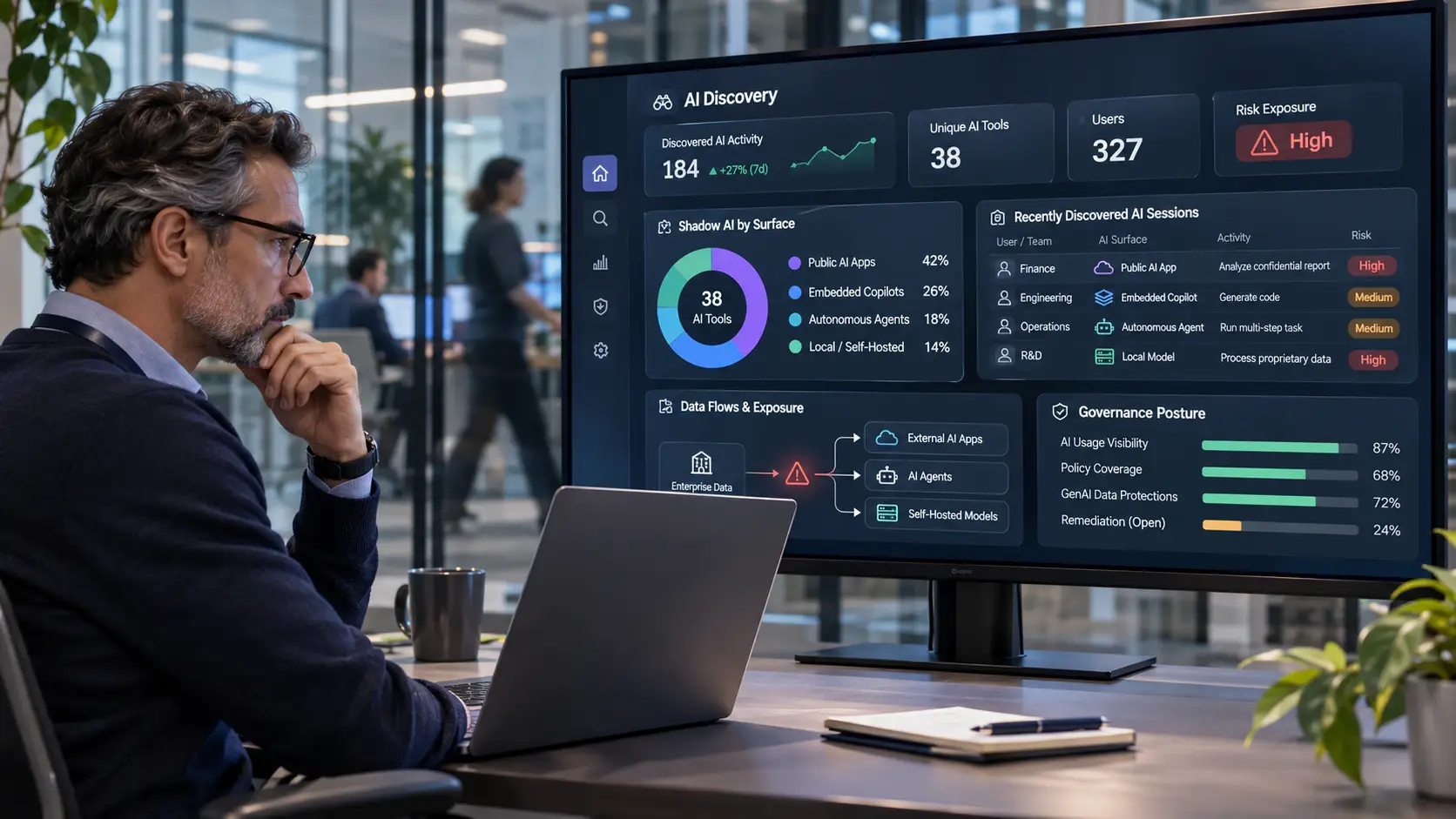
Security teams need continuous visibility into sanctioned and unsanctioned AI applications across enterprise AI environments. Discovery should identify not only application names but also users, devices, connected identities, model endpoints, agents, MCP servers and relevant integrations.
For example, knowing that an employee accessed an AI service is useful. Knowing that the employee submitted confidential financial information through an unmanaged account provides significantly more actionable context.
Discovery should therefore connect AI usage with identity and data exposure wherever the available integration supports that visibility.
2. Enforce Identity-Aware Access Policies
AI access decisions should consider the user, role, device posture, application trust and business requirements. An organization may permit employees to use an approved enterprise AI account while restricting unmanaged personal accounts.
Similarly, an autonomous agent should operate through a verifiable machine identity with appropriately scoped credentials. Policies should follow least-privilege principles rather than automatically extending the initiating user's entire permission set to an agent.
3. Apply Runtime Data Protection
AI Data Loss Prevention controls should inspect applicable prompts, file uploads and data transfers for sensitive information. Depending on policy and available enforcement points, security systems may:
- Allow authorized AI interactions.
- Redact sensitive information before disclosure.
- Block prohibited data transfers.
- Require human approval for higher-risk actions.
For autonomous agents, runtime protection should also include appropriate authorization checks and validation of sensitive tool operations.
The objective is to prevent unauthorized disclosure or execution before it occurs, rather than relying exclusively on post-event detection.
4. Establish Continuous Monitoring and Accountability
Security teams need auditable records of AI usage, policy violations, sensitive-data interactions and agent activities. Relevant events should be attributable to responsible human or machine identities and integrated into existing security operations processes.
Monitoring supports incident investigation, compliance reporting and continuous refinement of enterprise AI policies.
A Practical Framework for Managing Shadow AI
Organizations can introduce Shadow AI governance progressively without disrupting business productivity.
Phase 1 — Discover and Classify
Identify AI applications, users, agents and integrations. Classify sanctioned, unsanctioned and unknown AI usage, along with the sensitivity of associated data.
Phase 2 — Assess and Prioritize Risk
Evaluate application trust, data exposure, identity permissions and integration scope. Prioritize workflows involving regulated information, privileged credentials or autonomous operations.
Phase 3 — Enforce Contextual Controls
Implement identity-aware access policies, AI data protection and least-privilege authorization across enterprise AI environments. Introduce approval workflows for sensitive operations where appropriate.
Phase 4 — Monitor and Improve
Review security events, investigate policy violations and continuously update controls as new AI applications and agents enter the environment. The objective is to move from periodic application assessments toward continuous, risk-based governance.
Zaperon's Approach to Shadow AI Governance
At Zaperon, we approach Shadow AI as an extension of identity-centric enterprise security.
Our architecture is designed to secure AI adoption across the enterprise, encompassing Public GenAI Applications, AI Embedded in Enterprise SaaS, Autonomous Agents and MCP/A2A Workflows, and Self-Hosted or Local Language Models.
By bringing AI discovery, identity-aware access controls, sensitive-data protection and AI interaction monitoring together within a unified Security Service Edge architecture, Zaperon aims to enforce consistent security policies across these environments through a single control plane.
This extends Zero Trust principles beyond conventional application authentication into how human and non-human identities interact with enterprise applications, AI systems and sensitive data.
Our Enterprise AI Governance framework explains the broader governance architecture, while our Agentic AI Gateway architecture explores identity, authorization and runtime controls for autonomous AI workflows.
The goal is to enable secure enterprise AI adoption without introducing another isolated security silo.
Conclusion
Shadow AI is no longer limited to employees experimenting with public chatbots. It increasingly includes embedded SaaS copilots, internally deployed models and autonomous agents accessing enterprise systems.
For CISOs and CIOs, the priority is to establish visibility into these interactions and apply controls proportionate to their risks.
Effective Shadow AI governance connects discovery, identity, authorization, data protection and continuous monitoring.
The central question is not whether employees should be allowed to use AI. It is whether organizations can consistently protect enterprise identities, applications and data as AI adoption expands.